

Here’s the thing most folks in Durango get backwards: the work you do on your lawn in September and October matters more than anything you do in May. At 6,500 feet we get a short, bright fall and then a hard stop. Cool-season grasses — the Kentucky bluegrass, fescue and rye that make up nearly every lawn in La Plata County — do their heaviest root growth in exactly this window, when the days are still warm but the nights have cooled off.
Miss it and you spend spring playing catch-up. Hit it and your lawn comes out of dormancy already ahead. Three steps, and you can knock out the first two on a single Saturday.
Step 1: Aerate and Dethatch
Our soil around here is heavy and it compacts. Add a summer of foot traffic, dogs and irrigation, and you end up with ground that sheds water instead of drinking it. If you can’t push a screwdriver six inches into your lawn without leaning on it, you’re compacted.
A core aerator pulls plugs of soil out of the ground, opening channels for water, air and fertilizer to reach the root zone. Run it when the soil is moist but not soggy — water the day before if you’ve had a dry stretch. Two passes in a crosshatch pattern beats one pass every time. Leave the plugs on the lawn; they break down in a couple of weeks and feed the soil.
If you’ve got a thick spongy layer of dead material at the soil line — more than about half an inch — that’s thatch, and it’s blocking everything you’re about to do. A power rake or dethatcher pulls it up. Rake the debris off and get it out of there before you move on.
Helpful Tip
Flag your sprinkler heads, shallow irrigation lines and any invisible dog fence before you start. An aerator doesn’t know the difference between soil and a poly line, and neither does the guy running it.
The Ted’s Angle
Most people need an aerator for about three hours, not a whole day. That’s why we do a 4-hour rate — you’re not paying for time it sits in your driveway. Our Billy Goat AE401H 19-inch core aerator runs $90 for four hours or $120 for the day, and if you’d rather not wrestle it into a truck bed, we deliver. Pick it up at 7:00 AM Saturday and you’ll be done before the kids’ game.
Step 2: Overseed and Feed
Right after you aerate is the single best moment all year to put seed down. Those open holes give the seed direct soil contact, which is the whole ballgame — seed sitting on top of thatch just feeds birds.
In our climate, aim to get seed down by mid-September. That gives it enough warm soil to germinate and enough runway to establish roots before the ground freezes. Push it to late October and you’re gambling. Spread seed with a broadcast or drop spreader, going half the rate in two perpendicular passes rather than one heavy pass — it’s the difference between even coverage and a striped lawn next June.
Then feed it. A fall winterizer fertilizer is formulated differently than what you’d put down in spring: less nitrogen for top growth, more potassium for root development and cold hardiness. That’s the whole point of the fall application. Put it down after the seed, then water it in.
Keep the seedbed consistently damp for the first two to three weeks. Short, frequent watering — not the long deep soak you’d use on established turf.
Helpful Tip
Skip the weed-and-feed products this fall if you’ve just overseeded. The pre-emergent that stops crabgrass will also stop your new grass seed from ever coming up. Do one or the other this season, not both.
The Ted’s Angle
Seed selection matters more at our elevation than most bags on the shelf will tell you, and sun exposure on your particular lot matters more than either. Come talk to us before you buy — we’ve been putting seed on Durango lawns for 50 years and we’ll tell you honestly whether the cheap contractor mix will work for your yard or whether it’s money in the trash.
Step 3: Final Mow, Last Water, and Put It to Bed
Keep mowing as long as it’s growing. Grass doesn’t quit because the calendar says October — it quits when soil temperatures drop. For the last mow of the season, drop your deck to about 2 to 2.5 inches. Shorter than you’d normally cut, but not scalped. Long grass mats down under snow and invites snow mold; grass cut too short loses its insulation.
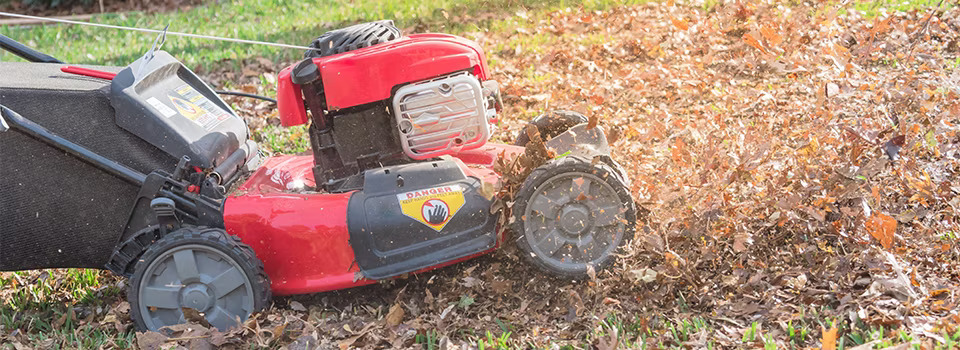
Get the leaves off. A matted leaf layer will smother turf over the winter and leave you with dead patches in April. Mulching them with the mower is fine if the layer is thin — if you’ve got cottonwoods, you’re raking or blowing.
Then the two jobs people forget until it’s too late. Blow out the irrigation before the first hard freeze, not after — a cracked manifold is a spring project nobody wants. And service the mower now instead of in April. Run the fuel out or stabilize it, and get the blade sharpened and the oil changed while our shop isn’t buried. In April everybody in the county remembers at the same time and you wait two weeks.
If you’ve got trees to deal with while you’re out there, fall is also the right time. Chain saws and pole saws, wood chippers for the brush pile, and log splitters if that deadfall is turning into this winter’s firewood.
⚠ Safety Alert!
Aerators and power rakes are heavier and pull harder than they look, especially on a slope. Wear closed-toe boots, keep kids and dogs inside while you’re running it, and don’t try to muscle it sideways across a hill. If your yard is steep, tell us — we’ll point you toward the right machine instead of the one that’ll fight you.
That’s it. Three steps across about two weekends, and you’ve done more for next year’s lawn than a whole spring of guessing. Your neighbors will ask what you did.
Project Shopping List
Here’s what you’ll need to get this done right.
- Core aerator (rent — 4-hour and day rates)
- Power rake / dethatcher (rent)
- Roto tiller (rent — if you’re starting a section from scratch)
- Chain saw or pole saw (rent)
- Wood chipper (rent)
- Log splitter (rent)
- Broadcast or drop spreader
- Grass seed — ask us about the right mix for your elevation and sun
- Fall winterizer fertilizer
- Compost or topdressing
- Leaf rake
- Garden hose and sprinkler
- Mower blade — or bring the mower in and we’ll sharpen it
- Tarp for hauling debris
- Work gloves
- Mower tune-up and blade sharpening — beat the April rush
Related Articles
When You Should Aerate Your Lawn
Timing is everything with aeration. Here’s how to read your lawn and pick the right window in our climate.
Learn more →Power Raking: Tools & Tips You Need
What a power rake actually does, when your lawn needs one, and how to run it without tearing up your turf.
Learn more →Rent the Equipment for Your Fall Yard Cleanup
Leaves, brush, deadfall and everything else the season leaves behind — and the right machine for each job.
Learn more →Best Projects to Finish Before Winter
The outdoor work that gets a lot harder once the ground freezes, and how to prioritize what’s left.
Learn more →Prepare for Winter with Firewood in Durango
Splitting, stacking and seasoning firewood — and the equipment that turns a week of work into an afternoon.
Learn more →
📍 999 College Drive, Durango, CO 81301 |
🕒 Mon–Sat: 7am–6pm | Sun: Closed |
📞 (970) 247-2930
Ted’s — Your Partner in Every Project.
Related Posts