

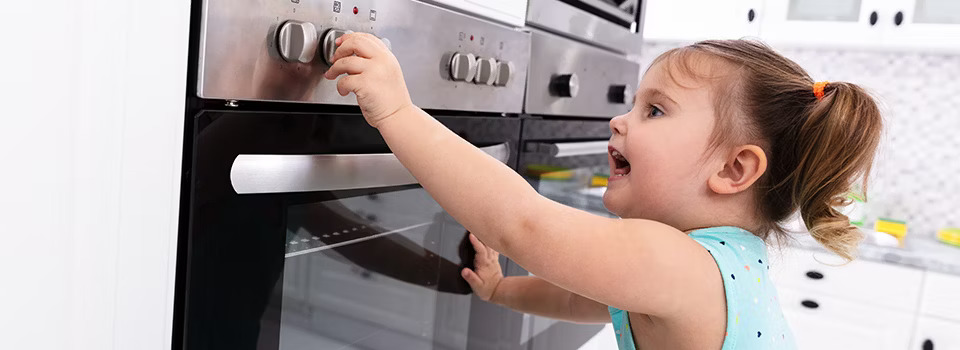
Every childproofing checklist on the internet was written for a two-story colonial in the suburbs. Ours weren’t. Durango homes come with wood stoves, steep exterior stairs, decks with a view and a drop, detached garages full of equipment, and a mudroom that’s part gear locker and part hazard closet.
So here’s a walkthrough that covers the standard stuff and the mountain-house stuff. Do it on a Saturday morning. Most of it costs less than dinner out.
Helpful Tip
Before you buy anything, get on your hands and knees and crawl through each room. Sounds silly. It works. You’ll spot the outlet behind the couch, the sharp corner at forehead height, and the cord you’d never notice standing up.
Step 1: Outlets and Cords
Every unused outlet within reach needs a cover. Skip the little plastic plugs that pull out with a tug — they’re a choking hazard themselves. Sliding outlet covers and box covers are the better call, and outlet and cord protectors are cheap enough that there’s no reason to do half the house.
Then deal with cords. Lamp cords, charger cables and blind pull cords are all strangulation and pull-down risks. Run them behind furniture, secure them with cable ties or cord channels, and cut looped blind cords or wrap them on a cleat well above reach.
Step 2: Cabinets, Drawers and Anything That Latches
Kitchen and bath cabinets get cabinet and drawer locks — magnetic ones are the least annoying for adults and the hardest for toddlers. Prioritize in this order: anything under a sink, anything with medication, anything with knives, then everything else.
Move cleaners and chemicals up high rather than relying on a latch alone. A latch is a delay, not a guarantee. That goes double for the garage, which we’ll get to.
Step 3: Stairs, Gates and Guardrails
Install a safety gate at the top and bottom of every staircase. At the top, use a hardware-mounted gate — the pressure-mounted kind can give way under a running kid. Pressure-mounted is fine at the bottom or in a doorway.
Check your railing spacing while you’re at it. Balusters more than four inches apart are a head-entrapment risk, and plenty of older Durango homes and cabins predate that standard. Temporary railing netting or plexiglass panels close the gap without a full rebuild. The same check applies to your deck railings — arguably more urgent out there, given what’s usually on the other side.
Step 4: Furniture and TV Tip-Overs
This is the one people skip and it’s the one that kills kids. Dressers, bookshelves and TVs all go over when a toddler climbs them. Anchor them to studs with anti-tip straps or brackets, and put a TV mount on anything big enough to matter.
Helpful Tip
Find the actual stud. A drywall anchor holding a loaded dresser is a false sense of security — it’ll hold right up until the moment it matters.
Step 5: Corners, Edges and Hard Surfaces
Coffee tables, hearths and stone countertop overhangs are all at exactly toddler-forehead height. Bump cushions and corner covers handle the worst of it. Fireplace hearths deserve special attention here — a raised stone hearth is the single most common source of stitches in a house with a walking one-year-old.
Step 6: Bathroom and Water
Toilet locks, faucet covers and a non-slip mat cover most of it — see toilet and tub safety. Turn your water heater down to 120°F to prevent scald burns; it’s a two-minute adjustment that also saves you money.
Never leave standing water unattended. Buckets, mop pails and the cooler you filled for the tailgate are all drowning hazards for a kid under two.
Step 7: Detectors, Extinguishers and the Wood Stove
This one’s less about childproofing and more about the whole house, but it belongs on the list. Smoke detectors on every level and in every bedroom. Carbon monoxide detectors too — and if you heat with wood, gas or propane, that’s not optional. Fresh batteries, tested.
Keep a fire extinguisher in the kitchen and another near the stove or shop. If you burn wood, put a hearth gate or freestanding screen around it. A stove that’s been running an hour will burn a hand instantly, and there’s no amount of “hot, don’t touch” that beats a physical barrier.
⚠ Safety Alert!
Homes built before 1978 may have lead paint. If yours is one of them and the paint is chipping anywhere a kid can reach, don’t sand it yourself and hope for the best. Test it first with a home testing kit, and learn the proper methods before you disturb anything by contacting the National Lead Hotline at 1-800-424-LEAD or visiting www.epa.gov/lead.
Step 8: Outside — the Part Most Checklists Miss
Around here, the outside is where the real hazards live.
- The garage and shop. Fuel cans, antifreeze, power tools, chainsaws. Lock the cabinet, or better, lock the room. Padlocks and hasps are cheap.
- Lawn and garden chemicals. Up high and locked, in original labeled containers. Never decanted into a drink bottle. Ever.
- Deck stairs and drop-offs. An outdoor gate at the top of deck stairs, and a hard look at any spot where the grade falls away.
- Water features and irrigation. Ponds, ditches, stock tanks and irrigation boxes. Cover, fence or fill.
- Gates and latches. Self-closing, self-latching, with the latch mounted above 54 inches on the outside of the gate.
- Trailers and equipment. If it’s parked in the yard, it’s a jungle gym as far as a four-year-old is concerned. Chock it, lock it or move it.
Helpful Tip
Redo this walkthrough every few months. A crawler and a climber are two completely different animals, and the house that was safe in March isn’t in September. New skills, new hazards.
The Ted’s Angle
Bring us a photo of the thing you’re trying to secure. Odd railing spacing, a hearth with a weird profile, a gate that won’t self-latch — these jobs almost never match what’s on the package, and after 50 years we’ve usually seen your exact problem before. If we don’t stock what you need, we’ll special-order it or tell you who does.
Nice work. None of this is complicated — it’s just a matter of actually walking the house and doing it. And the peace of mind is worth an afternoon.
Project Shopping List
Here’s what you’ll need. If we don’t have something on the shelf, we’ll special-order it — just ask.
- Outlet and cord protectors
- Cabinet and drawer locks
- Child safety gates
- Bump cushions and corner covers
- Toilet and tub safety hardware
- All-in-one child safety kit
- Anti-tip straps and brackets
- TV mounting hardware
- Smoke detectors
- Carbon monoxide detectors
- Fire extinguisher
- Non-slip treads and tape
- Cable ties and cord channels
- Padlocks and hasps
- Home safety testing kits
- First aid kit
- Anchors and installation hardware
- Deck posts and handrails
Related Articles
Declutter Your Garage: 5 Easy Storage Wins
Getting chemicals and tools up off the floor is half of childproofing a garage. Here’s how to make the space work.
Learn more →How to Repair Damaged Sheetrock
Fixing the wall after you’ve moved an anchor, a gate bracket or a mount that didn’t work out the first time.
Learn more →Beautify Your Lawn with Walkways and Fencing
Fencing does double duty when there are little kids in the house. Here’s what to consider before you build.
Learn more →Fix Scuffs & Dings: The Best Paint Touch-Up Tips
Kids are hard on walls. Here’s how to make the damage disappear without repainting the whole room.
Learn more →Condensation on Windows: How to Fix It
Moisture leads to mold, and mold is a health issue in a house with small kids. Here’s how to get ahead of it.
Learn more →
📍 999 College Drive, Durango, CO 81301 |
🕒 Mon–Sat: 7am–6pm | Sun: Closed |
📞 (970) 247-2930
Ted’s — Your Partner in Every Project.
Related Posts